This is the exact embedded text of the captured official document.
Snapshot 4e96d1e8721d · verified 2026-10-26 ·
original document ·
archived snapshot ·
unofficial consolidation, the official version is held by the municipal clerk.
### Business, Building & Development
# Development Cost Charges (DCCs)
#### About Development Cost Charges
Development Coast Charges (DCCs) are fees collected by local governments to help fund the cost of growth-related infrastructure expenditures. DCCs are regulated by the *Local Government Act*. The rates charged reflect the impact growth has on infrastructure, parks, and eligible protective services; the greater the impact, the larger the charge. This helps ensure development contributes its fair share towards the necessary growth-related infrastructure improvements that development benefits from.
DCCs help offset the cost of providing new infrastructure related to development. For example, they help build sewers, watermains, drainage, and roads.
**DCCs are a one-time charge, which are levied at:**
* subdivision
* building permit
#### Recent Changes
On September 29, 2025, Council adopted Development Cost Charges Bylaw No. 1329, 2025, replacing the Town's previous DCC Bylaw No. 1218 (2016, amended 2018).
**This update:**
* Responds to new legislative requirements under the Province's Homes for People Action Plan.
* Reflects updated infrastructure needs and increased capital costs for construction.
* Introduces revised definitions for housing types (e.g. low-, medium-, and high-density residential; garden suites; accessory dwelling units).
* Establishes new DCC rates for residential, commercial, industrial, and institutional development.
The adoption of Bylaw No. 1329 followed a full review process, including an information session on October 30, 2024, with the development community to provide feedback on the draft rates and bylaw.
View the Development Cost Charges Bylaw No. 1329, 2025
#### **In-stream Protection**
The 12-month in-stream protection period, which held the old DCC rates for in-stream applications, ended on **September 30, 2026.**
All of the following active in-stream applications are now subject to the new DCC rates under Bylaw No. 1329:
* Building permit applications,
* Precursor applications (rezoning and development permits), and
* Subdivision applications
If you have any questions, comments, or general feedback regarding the implementation of the above changes, please contact the Town at: [email protected].
#### Frequently Asked Questions
#### What are Development Cost Charges (DCCs)?
DCCs are fees collected by local governments to help fund the cost of growth-related infrastructure expenditures. DCCs are regulated by the Local Government Act. The rates charged reflect the impact growth has on infrastructure, parks, and eligible protective services, the greater the impact, the larger the charge. This helps ensure development contributes its fair share towards the necessary growth-related infrastructure improvements that development benefits from.
> Local Government Act
#### What do DCCS fund?
DCCs pay for capital cost upgrades needed to support growth by assisting in the funding of:
* Transportation Infrastructure
* Sanitary Sewer Infrastructure
* Water Infrastructure
* Drainage Infrastructure
#### What do DCCs NOT fund?
DCCs cannot be used to pay for:
* Replacing infrastructure solely to service existing residents
* Operations and Maintenance
* Community amenities or facilities such as recreation, affordable housing, libraries, etc.
* Replacing amenities solely to service existing residents
* Operations and Maintenance
* Affordable housing
#### Who pays the DCC?
DCCs are paid by applicants at time of approval for subdivision or building permit, as the case may be.
#### Can I receive a credit towards my DCC fees if I am completing service upgrades to Town infrastructure?
Yes, if your development includes upgrades to the Town's roads, water services, sanitary main, or stormwater collection system then you would be eligible for a credit towards your DCC fees. The creditable amount is based on the cost estimate provided by the Engineer of Record and would be completed as a dollar-for-dollar credit. Examples of DCC creditable works include road extensions, sidewalk installations, watermain extensions, upsizing an existing sanitary main, installing an offsite storm pipe. Please reach out to the infrastructure department if you are unsure whether you work would be creditable.
DCC fees include four categories of service: stormwater conveyance, roadworks, water, and sanitary. If the creditable cost of work within one category exceeds the DCC charges, it cannot be applied as a credit towards the remaining charges. For example, if a development is installing a watermain that has a higher cost of works than the watermain DCC charges, the remainder cannot be transferred as a credit to the sanitary charges. However, the Town can assist the developer to recover costs through a Latecomer Agreement.
#### Statutory Exemptions from DCCs
As per provincial legislation, the following are exempt from paying DCCs:
* Development in which a DCC has previously been paid;
* Development that does not impose a new capital cost burden;
* Places of Worship;
* Self-contained residential dwelling units no larger than 29 m2 (312 ft2); and
* Building Permits for work that does not exceed $50,000 in value.
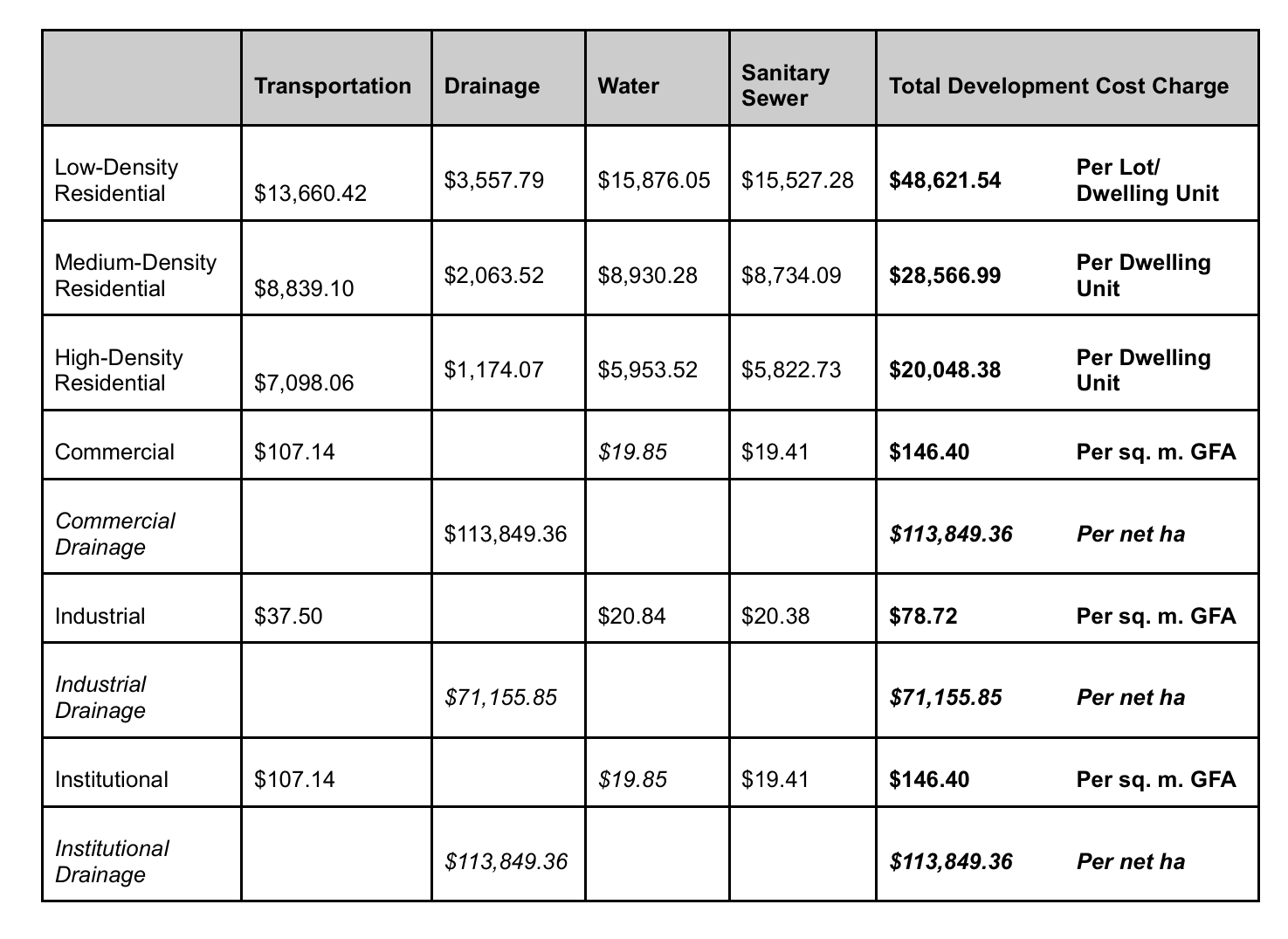
#### How are the DCCs calculated?
#### Latercomer Charges
Development applications are required to mitigate their impact to existing Town infrastructure and provide new infrastructure where it does not already exist. Latecomer charges, secured with a Latecomers Agreement, is a cost recovery tool for works that are triggered and funded by an Initial Developer; the agreement is entered into by a municipality and a land or property owner.
As part of the development process, the Town may require that a property developer construct infrastructure that serves not only their development, but also other lands in the neighbouring area.
Please contact the Town of Gibsons if you are interested in obtaining a Latecomer Agreement or would like to enquire about project eligibility.
| | | | | |
| --- | --- | --- | --- | --- |
| **Development Fee Category** | **Applicable Projects** | **Applicable Project Areas** | **Payment Deadlines** | **Additional Resources** |
| Development Cost Charges | Subdivision of land, or construction of additional dwelling unit on existing property | Everywhere within Town Boundaries | Paid at the time of subdivision. For construction of additional dwelling units on previously subdivided property, fees may apply, and must be paid prior to obtaining Building Permit | DCC By-law |
| Latecomers Fees | Construction of a dwelling unit on existing property, or installing site servicing to an existing property | Applies to areas serviced by the Prowse Road Lift Station; refer to the map provided within Bylaw 1261. | To be paid prior to building permit or prior to completing service connection, whichever comes first | Bylaw 1261 - 2018 - Prowse Road Latecomer Fees |
| Service Upgrade Fees | Building permits within all zoning types, including construction of a new building, or alteration/addition to an existing building | Anywhere within Town Boundaries | Prior to obtaining Building Permit | Required upgrades are project dependent and may include installation of storm/sanitary IC, connection to Town sanitary or stormwater collection system, water meter replacement or other noted deficiencies. |
| Security Deposits | Applicable to all projects that require a Servicing Agreement | Anywhere within Town Boundaries | Prior to obtaining Servicing Agreement (prerequisite for Building Permit) | Subdivision and Development and Stormwater Management Bylaw 1175 - Section 5, Schedule B & C |
### Latercomer Agreement
#### What is a Latecomer Agreement?
Latecomer Agreement is a financial agreement where one developer pays upfront for public infrastructure (like sewers or water mains) needed for their project, including extra capacity for future growth. The Town then collects these costs from later developers who connect to that same infrastructure within a set period (12 years within the Town of Gibsons), reimbursing the initial developer.
Essentially, it allows big projects to proceed, ensures future users pay their share, and prevents early developers from bearing the full cost of servicing future growth.
The Local Government Act provides the authority for municipalities to require Latecomer Agreements to fund new infrastructure.
#### What do Latecomer charges fund?
| | |
| --- | --- |
| **Sewers** | Construction of a new sewer or drainage system where a sewer or drainage system did not previously exist |
| Upgrade of an existing sewer or drainage system and the Town requests that the Developer oversize the system to provide servicing capacity greater than the needs of the initial development |
| **Water** | Construction of a new water main where a water main did not previously exist |
| Upgrade of an existing water main and the Town requests that the Developer oversize the system to provide servicing capacity greater than the needs of the initial development |
| **Street** | Construction of wider sidewalks or new sidewalks where they previously did not exist beyond the frontage of the property |
| Construction of improved cycling facilities (e.g. wider or separated) and new cycling facilities where they previously did not exist that extend beyond the frontage of the property |
| Net-new vehicular lanes or road structure upgrade the extend beyond the frontage of the property |
| Major geometric changes |
| Single and intersection improvements |
#### Who pays the Latecomer charge?
Latecomers' charges are imposed on every person who obtains approval of a subdivision or a building permit according to the provisions of the Local Government Act.
> Local government latecomer agreements - Province of British Columbia
The Initial Developer shall pay all costs associated with the Excess or Extended Services and is required to enter into a Latecomer Agreement with the Town in accordance with this Policy. The Town shall charge Subsequent Developers upon connection to or use of an Upgrade that constitutes Excess or Extended Services based on the provisions in the Latecomer Agreement with the Initial Developer.